TL;DR — Stickam
Stickam was one of the first live-streaming and webcam chat websites, running from 2005 to 2013. At its peak it had around 10 million registered users, was named a “Top Video Destination for Teens” by Nielsen, and launched the careers of early internet stars. It shut down suddenly on 31 January 2013 and was never revived — overtaken by YouTube, Twitch and the shift to mobile, and dogged by safety problems. Today the original site is gone, so any “Stickam” you see now is an unrelated adult cam site.
- What it was: live webcam streaming + one-to-many and group video chat
- Status: permanently shut down on 31 January 2013
- Why it mattered: pioneered the “stick your cam on any site” embeddable stream
- Modern equivalent: free random video chat like Chat to Strangers; Twitch or YouTube Live for broadcasting
Stickam was one of the internet’s earliest live-streaming platforms — a place where anyone could switch on a webcam and broadcast to the world years before Twitch, TikTok LIVE or Instagram Live existed. For a stretch of the late 2000s it was the home of scene kids, emo bands and a first wave of internet celebrities. Then, on 31 January 2013, it vanished almost overnight. This guide explains what Stickam was, why it shut down, the legacy it left behind, and the best ways to get the same experience today.
Stickam at a glance
| What it was | Live webcam streaming and video chat website |
| Launched | 2005, Los Angeles (Advanced Video Communications) |
| Izklopi | 31 January 2013 (downloads open until 28 Feb 2013) |
| Peak size | ~10 million registered users; ~3 million streams viewed daily (2012) |
| Recognition | Nielsen “Top Video Destination for Teens”, 2008 |
| Cena | Free (account required to broadcast) |
| Technology | Adobe Flash embeddable webcam player |
| Reason for closure | Never officially stated; competition + Flash decline + safety issues |
| Current status | Defunct — original site permanently offline |
| Closest today | Random video chat (Chat to Strangers); Twitch / YouTube Live |
Kaj je bil Stickam?
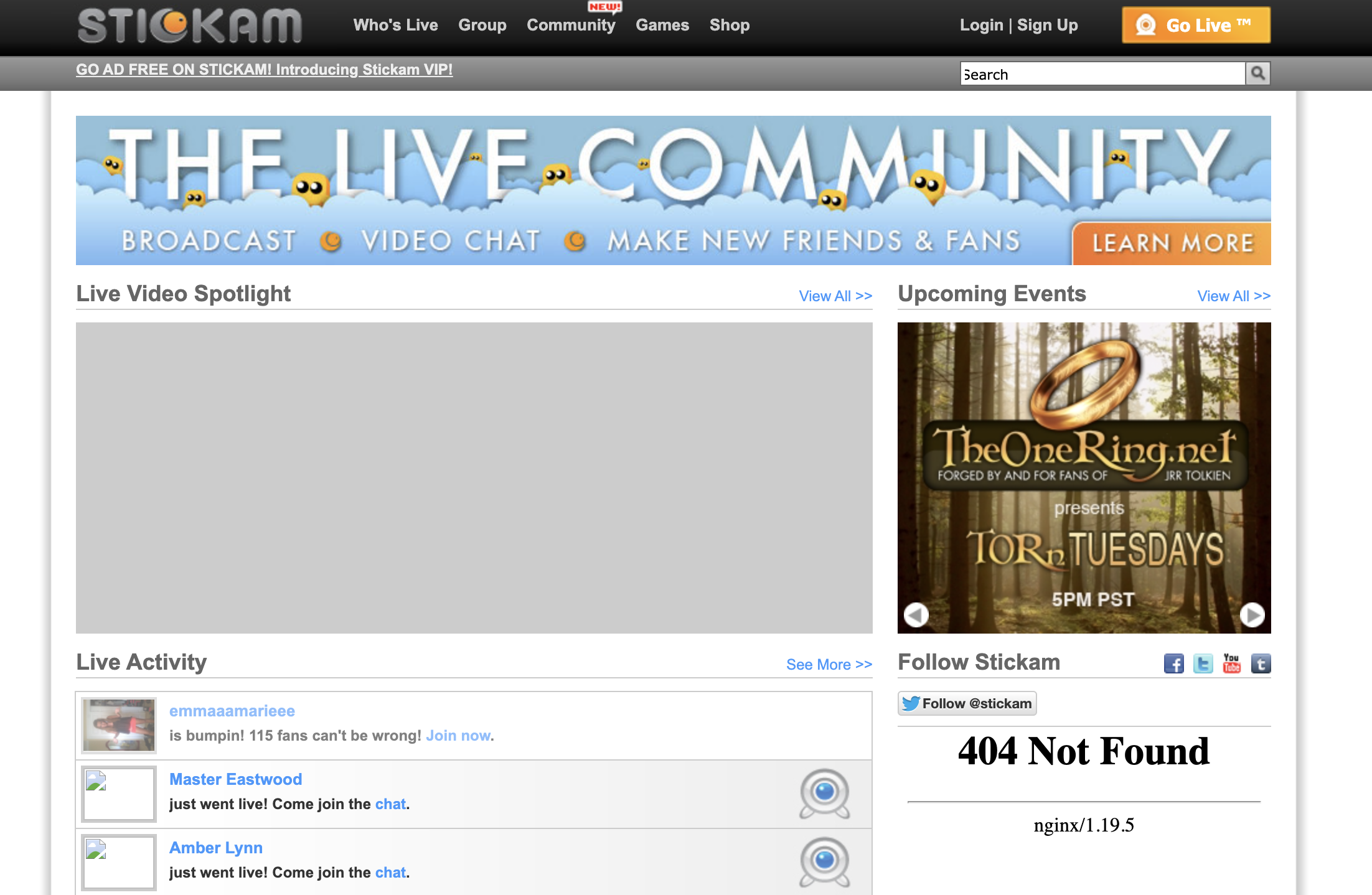
Stickam was a free, browser-based live-streaming and video chat website that let users broadcast their own webcam feed and interact with viewers in real time through text and video chat. Its defining trick was in the name: you could “stick” your live webcam stream onto other websites by embedding a Flash player, effectively turning any page into a live broadcast. Anyone could go live in seconds from a computer — and later an iPhone or iPad — while more advanced users plugged in HD cameras and mixers for near-professional broadcasts. Alongside solo streams, Stickam ran multi-user chatrooms, social profiles and follower communities, making it part live-streaming service and part social network.
When did Stickam launch — and when did it shut down?
Stickam launched in 2005 in Los Angeles, operated by Advanced Video Communications, and described itself as the first website devoted to live streaming, user-generated video and chat. It ran for roughly eight years before closing on 31 January 2013. The end was abrupt: the company posted a shutdown notice with only about a day’s warning, then took the site dark. It stayed accessible until 28 February 2013 purely so members could log in and download any recordings they wanted to keep — after that, everything was gone. There was no acquirer and no successor.
Why did Stickam shut down?
Stickam never gave an official reason, saying only that it had done everything it could to “keep this dream alive.” Looking back, a few forces clearly stacked up against it:
- Mainstream competition. By 2013, YouTube, Ustream, Livestream, Google Hangouts and Justin.tv (soon to become Twitch) all let people stream live video to far bigger audiences — and pay creators to do it.
- The decline of Flash. Stickam’s embeddable player was built on Adobe Flash, exactly as the web was moving to HTML5 and mobile apps that didn’t support it.
- An ageing, fracturing audience. Its core “scene kid” community grew up and drifted to newer platforms, and no clear next generation replaced them.
- Persistent safety controversies. With millions of mostly teenage broadcasters and thin moderation, Stickam was repeatedly linked to predator-safety and harassment problems, which damaged its reputation with users, parents and advertisers.
How popular was Stickam at its peak?
Very. In its heyday — roughly 2007 to 2010 — Stickam grew to around 10 million registered users, with several million monthly visitors and roughly 3 million streams viewed each day. Nielsen named it a “Top Video Destination for Teens” in 2008. It hosted produced content and live coverage with partners including MTV and G4, streamed events like the Vans Warped Tour and SXSW, and powered years of Myles Dyer’s charity “Stickaid” fundraisers. For a few years, Stickam was the default place young people went to be live on camera.
Kakšna vsebina je bila na Stickam?
Mostly everyday broadcasting: people hanging out, playing music, chatting with friends and building small live audiences. Musicians used it to perform and connect with fans, and it ran official live shows and event coverage. Because it was open, live and lightly moderated, Stickam also attracted adult and risqué content, which fed the moderation controversies that followed it throughout its life. That open, unfiltered nature was both the source of its early energy and a major factor in its downfall.
Notable Stickam users and moments
Stickam was an early launchpad for creators who later became far bigger names. A number of them cut their teeth broadcasting to its live audiences:
- Jeffree Star — the musician-turned-makeup mogul, who built an early following through scene-era platforms including Stickam.
- Chris Crocker — best known for the viral “Leave Britney Alone” video, but an active, dramatic presence on Stickam beforehand.
- Shane Dawson — among the early internet entertainers who used the platform before finding a mass audience on YouTube.
- GayGod and other “Stickam celebrities” — home-grown stars who built followings on the site, several of whom later moved to YouTube.
- Guest performers — established acts such as Andrew W.K. appeared for live sessions and Q&As.
Stickam also became a cautionary tale. High-profile cases — such as teen user “Kiki Kannibal,” who became a hit on the site only to be stalked and harassed by fans — highlighted how exposed young broadcasters could be, and are a big part of why the platform is remembered as much for its risks as its reach.
Is Stickam still available?
No. The original Stickam has been permanently offline since early 2013 and was never rebooted or bought out. Importantly, the Stickam domain was later picked up by an unrelated operator, so any site using the “Stickam” name today is not the original — it is generally an adult cam site with no connection to the platform described here. If you landed here looking to relive Stickam or find your old account, there’s nothing official left to return to. The good news is that the core experience — going live and meeting strangers on camera — is easy to get elsewhere.
The best Stickam alternatives in 2026
Stickam really did two things: it let you broadcast to an audience, and it let you meet and chat with people live on webcam. Which alternative fits depends on which half you’re after.
To meet strangers live on camera → free random video chat. If what you miss is the thrill of jumping on cam and talking to someone new, a random video chat service is the closest modern equivalent — and you don’t need to build an audience first. Chat to Strangers pairs you with a new person in seconds, right in your browser, with no download and no sign-up to start.
To broadcast to a following → Twitch or YouTube Live. For streaming to a growing audience with chat, alerts and monetisation, Twitch and YouTube Live are the mainstream successors to what Stickam started. TikTok LIVE and Kick are newer options worth knowing if you want a mobile-first or up-and-coming platform.
Was Stickam safe? What its legacy tells us
Stickam’s safety record was genuinely mixed, and it’s worth learning from. A platform full of young people broadcasting live from their bedrooms, with limited moderation, created real risks — and Stickam faced repeated criticism over exactly that. If you’re using any live or random chat site today, the same common-sense rules apply, but modern platforms give you far better tools to enforce them:
- Guard personal details. Don’t share your full name, address, phone number, school or workplace on camera.
- Watch your background. Assume anything on screen could be screenshotted — keep your surroundings neutral.
- Use report and block. Today’s random chat services have instant reporting and blocking; use them the moment something feels off.
- Trust your instincts. If a chat feels wrong, end it — you never owe a stranger an explanation.
Frequently asked questions
Is Stickam still around?
No. The original Stickam permanently shut down on 31 January 2013 and has never been revived. Any website using the Stickam name today is unrelated to the original and is generally an adult cam site, so treat it with caution. For the modern equivalent, use a live random video chat service such as Chat to Strangers instead.
When did Stickam launch and when did it shut down?
Stickam launched in 2005 in Los Angeles and was operated by Advanced Video Communications. It shut down on 31 January 2013 after posting a closure notice with roughly one day of warning. The site stayed online until 28 February 2013 so members could download their recordings.
Why did Stickam shut down?
Stickam never gave an official reason for closing. It is widely attributed to being overtaken by mainstream streaming platforms like YouTube, Ustream and Justin.tv/Twitch, the decline of Adobe Flash that its player relied on, an ageing core audience, and persistent moderation and safety controversies tied to its young user base.
Was Stickam safe?
Stickam had a mixed safety record. It offered free live webcam broadcasting to millions of mostly teenage users but struggled with moderation, and it was linked to several predator-safety and harassment cases during its lifetime. Modern random chat platforms have far stronger reporting, blocking and human moderation, though the basic rules for talking to strangers online still apply.
What are the best Stickam alternatives in 2026?
For meeting new people live on webcam, a free random video chat service like Chat to Strangers is the closest modern equivalent. For broadcasting to an audience, Twitch and YouTube Live are the mainstream successors, with TikTok LIVE and Kick as newer options.
Can I still recover my old Stickam videos?
Officially, no. Stickam only allowed downloads during a short window that ended on 28 February 2013, after which recordings were removed. Some clips survive on third-party archives and YouTube re-uploads, but there is no way to retrieve your original Stickam account or media today.
The bottom line
Stickam was a true pioneer — the first place millions of people went to be live on camera, and an early launchpad for creators who defined the internet that followed. Its sudden 2013 shutdown, driven by tougher competition, dying Flash technology and unresolved safety problems, closed the book on the desktop-webcam era. The platform itself isn’t coming back, but its core appeal never went away. If you want that same instant, face-to-face spark of meeting someone new, a free random video chat is the natural place to pick up where Stickam left off.
Več aplikacij za anonimno pogovor z neznanci
Tukaj se lahko pogovarjate z neznanci: