
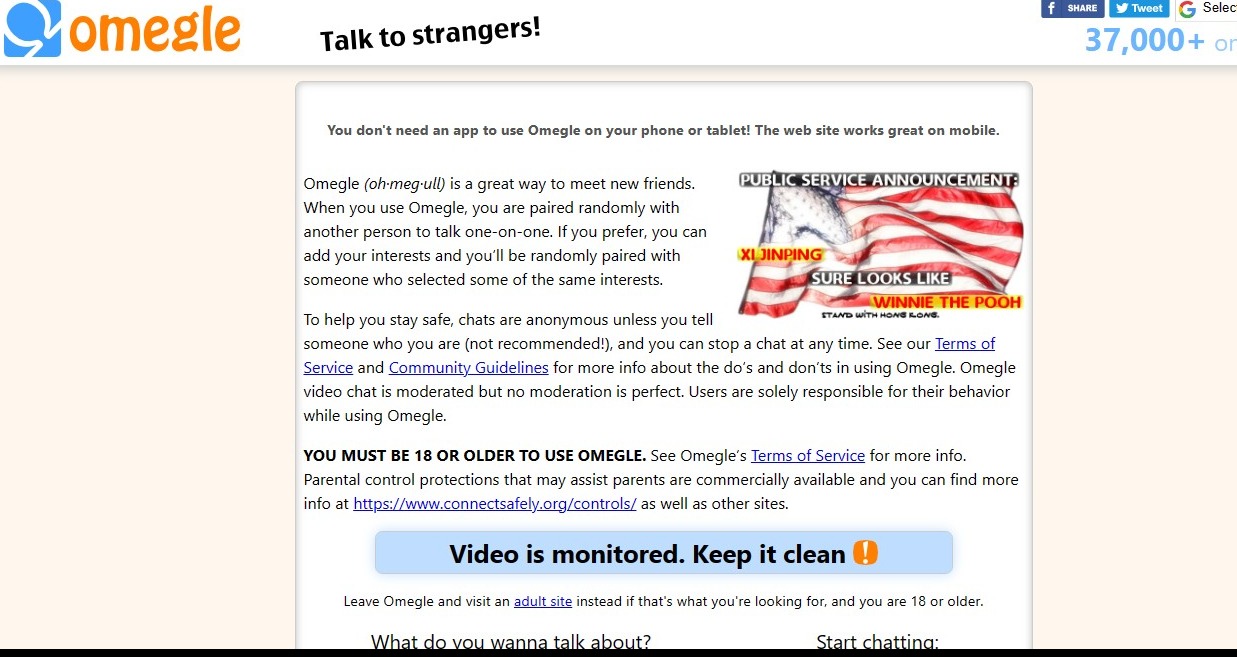
TL;DR — Is Omegle Still Around?
Omegle shut down permanently on 8 November 2023, after 14 years online — and it is not coming back. Founder Leif K-Brooks closed it under mounting legal pressure and the impossible cost of moderating an anonymous, no-signup video service. If a site today calls itself “Omegle,” it’s an unofficial clone. The random chat video demand Omegle created is still huge; it has simply moved to newer, moderated platforms.
- Status: permanently closed since November 2023
- Coming back? No — the founder has confirmed it won’t return
- Why it closed: lawsuits, safety/CSAM misuse, unsustainable moderation cost
- What to use instead: moderated, 18+ chat video aleatoriu like Bazoocam
For 14 years, Omegle was the internet’s default place to “talk to strangers.” Then, on 8 November 2023, it vanished overnight — the chat box replaced by a several-thousand-word farewell letter from its founder. If you’ve landed here wondering whether Omegle is back, whether it’s safe, or what you can use in its place in 2026, this guide has the straight answers: what Omegle was, exactly why it shut down, whether it’s ever returning, and the live alternatives worth your time.
Omegle at a glance
| What it was | Free, anonymous random text & video chat with strangers |
| Founded | 2009 by Leif K-Brooks (aged 18) |
| Motto | “Talk to strangers!” |
| Current status | Permanently shut down on 8 November 2023 |
| Coming back? | No — founder confirmed it will not return |
| Why it closed | Lawsuits, misuse for abuse, unsustainable moderation cost |
| Official app today | None — all “Omegle” apps are unofficial clones |
| Best live alternative | Bazoocam (free, moderated, no signup) |
Is Omegle back in 2026?
No — Omegle is permanently closed and it is not coming back. If you visit the old address today you’ll find only a memorial-style shutdown message, not a working chat. The founder has been explicit that there are no plans to relaunch. So if you’ve seen a website or app claiming to be “the new Omegle,” understand that it has no connection to the original — it’s a copycat trading on a famous name, and its safety and moderation are entirely its own.
What happened to Omegle?
On 8 November 2023, founder Leif K-Brooks took Omegle offline the same day he published a long open letter addressed “Dear Strangers.” In it he defended the original vision of the site — spontaneous human connection with anyone in the world — but acknowledged what everyone already knew: that some people had misused it, “including to commit unspeakably heinous crimes.” There was no wind-down and no warning. One day the site loaded its familiar chat box; the next it loaded a goodbye.
The immediate catalyst was legal. Omegle had been named in numerous cases involving child exploitation, and a lawsuit filed by a young woman — identified only as “A.M.” — alleged the site had matched her, at age 11, with an adult who went on to abuse her. She sought $22 million in damages. Omegle was taken offline days after the two sides agreed to settle.
Why did Omegle shut down?
There was no single reason — it was the collision of several pressures that had been building for years:
- Legal liability. A string of lawsuits tied the platform to serious abuse, culminating in the settled A.M. case. The legal risk of running an anonymous service used by minors had become existential.
- Impossible moderation. Omegle paired anonymous strangers with no accounts and no meaningful age verification. Policing that in real time, at scale, on a shoestring was never truly achievable — and the abuse that slipped through was severe.
- Regulatory pressure. Tougher rules such as the UK’s Online Safety Act raised the bar for protecting under-18s, adding cost and exposure the site couldn’t meet.
- Personal toll. K-Brooks described the financial strain and stress of fighting misuse as unsustainable, writing that “what is right doesn’t always prevail.” Running the fight largely alone finally became too much.
Was Omegle ever safe?
Honestly, not very. Its defining feature — total anonymity with no sign-up and no reliable age check — was also its core weakness. That openness attracted a steady stream of explicit content, harassment and predatory behaviour, and light moderation couldn’t keep pace. The lessons from Omegle’s collapse are exactly what you should apply to any chat aleatoriu platform you use today:
- Never share personal details. No full name, address, phone number, school, workplace or financial information — ever.
- Assume you’re being recorded. Anything on camera can be screenshotted. Keep your background neutral and your face the only identifiable thing on screen.
- Prefer moderated, 18+ platforms. Choose services that clearly show active moderation and reporting/blocking tools rather than an anonymous free-for-all.
- Trust your instincts. If a chat feels wrong, skip it instantly. You never owe a stranger an explanation.
- Keep minors away. Random video chat is an adults-only activity; Omegle’s downfall is the clearest possible warning why.
Omegle alternatives that actually work in 2026
The demand Omegle served didn’t disappear when the site did — it moved to platforms that treat moderation as the product rather than an afterthought. If you’re chasing the same instant, no-commitment “meet a random stranger” experience, start here:
- Bazoocam — the closest spiritual successor for casual users: free, no sign-up, geolocation matching, built-in mini-games and 40+ human moderators. Our top pick for most people leaving Omegle behind. Read our full Bazoocam review →
- Chatroulette — the other original random cameră web site, still running and now with AI-assisted moderation to cut down on inappropriate content.
- Emerald Chat — a cleaner, more community-focused take on random chat, with interest matching and text or video modes.
Whichever you try, the rule of thumb is the same: pick a platform that is actively maintained and moderated, and steer clear of any app or site simply reusing the Omegle name to ride its search traffic.
What was Omegle, and how did it work?
For anyone who never used it: Omegle was an anonymous chat service that paired you with a random stranger for a one-on-one conversation, in either text or video. There were no profiles and no registration — you were simply “You,” and the other person was “Stranger.” You’d open the site, pick text or video, optionally add a few interest tags to nudge the matching, and you were connected. Didn’t click? You disconnected and got someone new. That raw randomness — you never knew who’d appear next — was the whole appeal, and it’s what a generation of internet users remember. It’s also, ultimately, what made the platform impossible to keep safe.
Why people loved it — and why it failed
| What made Omegle popular | What ultimately brought it down |
|---|---|
| Total anonymity — no account, no data | Same anonymity made abuse easy and users unaccountable |
| Instant, spontaneous connections | No age verification meant minors were exposed to adults |
| Huge global user base | Scale made real-time moderation impossible |
| Completely free, forever | No revenue model to fund safety infrastructure |
| A genuine cultural phenomenon | Repeated lawsuits and regulatory pressure ended it |
Frequently asked questions
Is Omegle back in 2026?
No. Omegle shut down permanently on 8 November 2023 and has not returned. The original site now shows only a farewell message, and founder Leif K-Brooks has confirmed it will not come back. Any site or app currently calling itself Omegle is an unofficial clone.
Why did Omegle shut down?
Because the legal, financial and emotional cost of fighting misuse became unsustainable. Years of lawsuits over child safety, pressure from regulations like the UK Online Safety Act, and the near-impossibility of moderating an anonymous, no-signup video service run largely by one person made the model impossible to continue. The founder announced the closure himself in a public farewell letter.
Is Omegle coming back?
No. The founder has said Omegle will not return, and there are no plans to relaunch it. The random video chat demand it created has moved to newer platforms that build in moderation and 18+ checks.
Are sites claiming to be Omegle safe to use?
Treat them with caution. Any current site or app using the Omegle name is a copycat with no connection to the original, and safety varies enormously. Prefer established platforms that clearly show active moderation, reporting and blocking tools, and an 18+ requirement — and never share personal details with a stranger.
What is the best alternative to Omegle?
It depends on what you liked about Omegle. For fast, free, no-signup random video chat with built-in games and human moderation, Bazoocam is a strong pick. Chatroulette and Emerald Chat are other well-known live options. Choose a platform that is still actively maintained and moderated rather than an Omegle clone.
Who created Omegle and when did it launch?
Omegle was created by Leif K-Brooks in 2009, when he was 18. It ran under the motto “Talk to strangers!” for 14 years before shutting down in November 2023.
The bottom line
Omegle is gone for good. It proved there’s an enormous, lasting appetite for talking to strangers online — and that anonymity without moderation is a liability that eventually catches up with you. That’s the real takeaway if you’re looking for the same experience today: the platforms that will still be here in five years are the ones treating safety as the product, not an afterthought. If you want the closest thing to old-school Omegle without the risk, start with a free, moderated option like Bazoocam.
Mai multe aplicații pentru a vorbi anonim cu străinii
This is where you can vorbește cu străinii:


